
Dubuque Directory Collections by Era
Dubuque has an unusually long, open digital run. The City of Dubuque and Carnegie-Stout Public Library archive contains 70,999 scanned pages covering 1856 through 1991. It is the main city directory collection for a name, address, or year search. The Center for Dubuque History at Loras College adds directories, census schedules, plats, maps, and an obituary file. Older county records preserved by the State Historical Society of Iowa extend the trail beyond printed directories.
| Collection | Years | Where Held | Access |
|---|---|---|---|
| Dubuque City Directory scans | 1856-1991 | City archive and Carnegie-Stout | Free online search, OCR, and page images |
| R.L. Polk sample volume | 1983 | City digital archive | Alphabetical, street, telephone, business, and taxpayer sections |
| Directories and local indexes | Collection-specific | Center for Dubuque History | Onsite; copies or staff research may carry a fee |
| County record microfilm | 1819 onward, by series | State Historical Society | Catalog and Research Center access |
The archive does not promise one issue for every year, and 1991 is its final digitized year. No separate, fully dated local criss-cross run was found. Later volumes often include street-order sections, but that feature must be checked volume by volume. A blank result can reflect missing OCR, a skipped issue, changed spelling, or a person outside the publisher's canvass. It does not prove the person was absent from Dubuque.
Dubuque's 70,999-Page Archive
The digitized Dubuque directory archive can be browsed by year or searched as text. The 1960s account for 11,443 pages, while the 1970s contain 11,125. Search several forms of a surname, then narrow by year or street. OCR, the machine-read text behind the search, often misreads faded type, initials, columns, and short forms.
The collection grew from bound volumes and microfilm at Carnegie-Stout. A 2014 city project, backed by the Dubuque Old House Enthusiast Club and a State Historical Society grant, put those pages online. That preservation story matters when a search fails. Browse nearby alphabetical pages and inspect the image. A surname may be clear to a person even when the index cannot read it.
Read a Dubuque Directory Entry
A 1913 Dubuque city directory entry can compress a household into one line. It may give the resident's name, spouse, trade, employer, home address, telephone, and lodging status. The original page uses short forms such as wf for wife, wid for widow, r for resides, bds for boards, rms for rooms, wks for works, and elk for clerk. Read the volume's key before deciding what a mark means.
| Name and spouse | The listed adult, sometimes followed by a spouse or widow notation |
|---|---|
| Work | Trade and often an employer, useful for separating the same name |
| Residence | A numbered address, hotel, or landmark phrase; r same can tie home to a prior address |
| Lodging | bds and rms signal boarding or rooms, not always a family household |
| Telephone | A number may appear in later entries and help confirm a match |
- Criss-cross directory
- A street-order section that starts with an address and returns a listed householder or business.
- Householder index
- An address list of the main person tied to a home, not a census of all occupants.
- Abbreviation key
- The publisher's legend for short terms. Save it because meanings can change by volume.
A hotel entry and a private home entry are not equal proof of a household. One inspected line places a worker at Central Hotel, while another uses a street address and spouse. Keep each role intact. A listed workplace is a historical clue only, not evidence of a later connection.
Inside Dubuque's 1983 Directory
The 1983 R.L. Polk volume is broader than an alphabetical name list. Its front matter identifies a buyers' guide, classified business pages, a street directory of householders and businesses, a numerical telephone section, a general index, and a statistical review. It also includes East Dubuque and a Dubuque County taxpayers directory. Record that wider scope when citing a result, since a printed Dubuque entry is not always proof of residence within city limits.
Polk said its information came from door-to-door canvassing and did not guarantee accuracy. That caveat helps explain missed households, stale facts, and spelling errors. Treat a city directory as a dated snapshot. Confirm a promising entry with another year, a census schedule, a deed, a newspaper item, or a parcel record.
The volume's internal sections also answer different questions. Alphabetical pages move from a name to an address. Street pages move from an address to a listed householder or business. The taxpayer section reflects its own publisher scope and should not be read as a list of occupants. A numerical telephone section can join a number to an entry, but shared service and later reassignment limit what it proves. Note the section title with every citation.
Dubuque Directory Help at Carnegie-Stout
Carnegie-Stout Public Library's genealogy resources combine open and card-based access. The city directory is open to all. HeritageQuest offers local histories, census records, and maps from home with a Dubuque resident card. Ancestry Library Edition is listed for library-only use. The Telegraph Herald archive contains thousands of local newspaper issues dating into the 1800s, while Encyclopedia Dubuque supplies local articles and images.
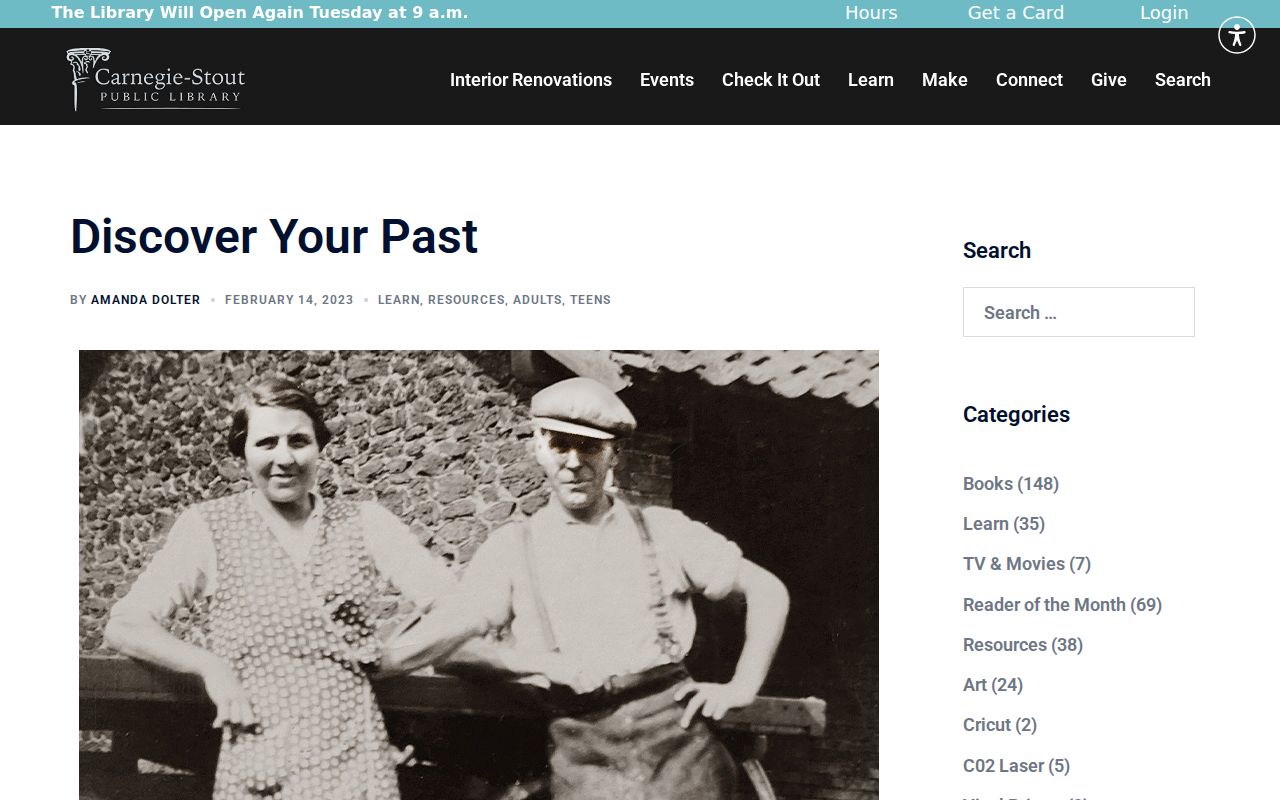
The image shows the library's current discovery routes, which help move from a directory entry to a census or newspaper. Carnegie-Stout is at 360 W 11th Street and can be reached at 563-589-4225. Listed hours are Monday through Thursday, 9:00 a.m. to 7:00 p.m.; Friday and Saturday, 9:00 a.m. to 5:00 p.m.; and Sunday, noon to 5:00 p.m.
Remote access depends on the resource. The directory and Encyclopedia Dubuque are open. HeritageQuest and newspaper tools may require a local card, while Ancestry Library Edition is listed for use inside the library. A separate county library notice says its Ancestry access ended in late 2025, so do not assume the same rule at every branch. Ask staff which database is current before relying on an old access note.
Dubuque Records Beyond Directories
The Center for Dubuque History at Loras College is the strongest local companion to a city directory find. Its holdings include federal census records for Dubuque County from 1840 through 1930, Iowa special censuses, an alphabetical obituary file, a WPA newspaper index, directories, plat books from 1874, 1892, and 1906, and a 1909 Sanborn map. Unique materials do not circulate. Scans, copies, and staff research may carry a fee.
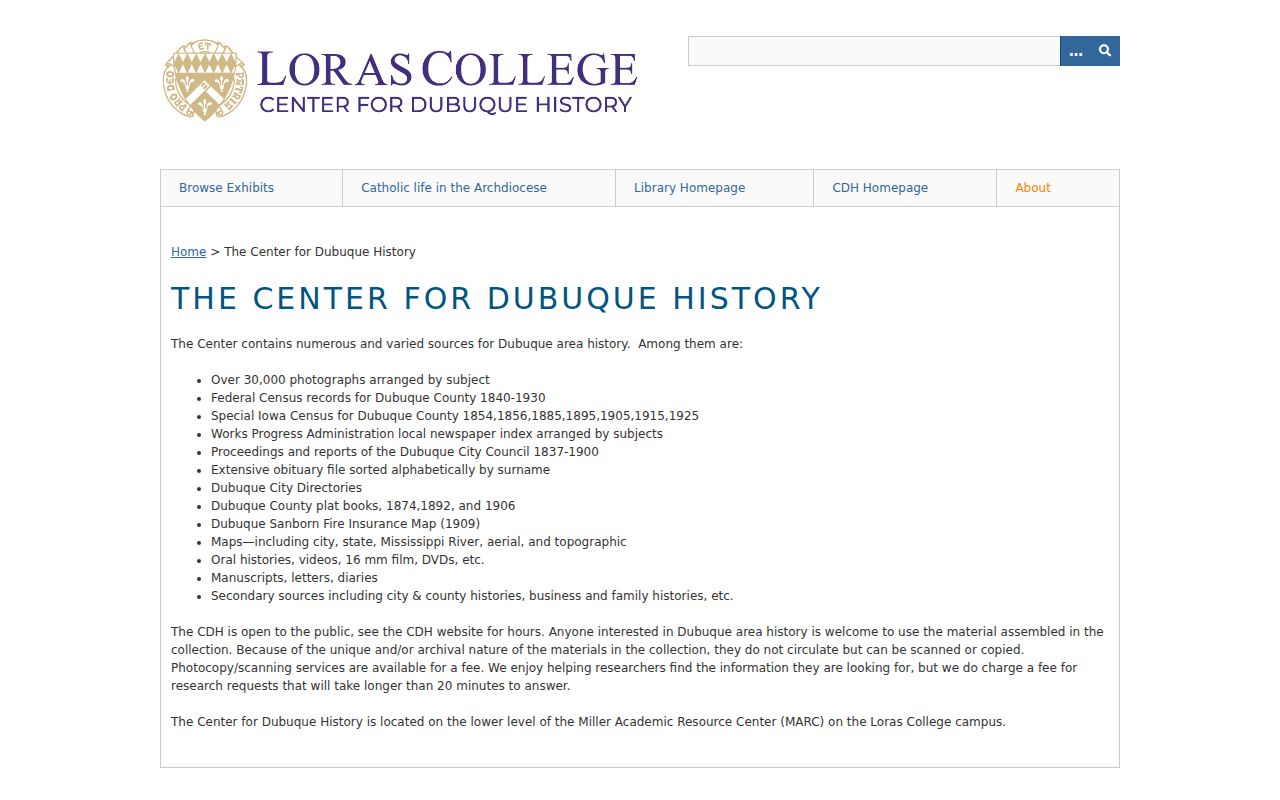
The collection view points to an archive that can move a name into a census household, obituary, plat, or map. Special Iowa censuses for 1854, 1856, 1885, 1895, 1905, 1915, and 1925 are especially useful between federal census decades.
The Center also holds council proceedings from 1837 to 1900, maps, oral histories, family papers, and a WPA newspaper index arranged by subject. These sources can explain a directory change that the printed line cannot. An obituary may identify relatives, a plat may anchor an old lot, and a council record may connect a name to an address or project. Ask for a narrow name, year range, and record type because research lasting more than 20 minutes may be charged.
Dubuque Directory Gaps and Microfilm
The State Historical Society's Dubuque County catalog supplies dated series when the city directory archive runs out. It lists deed and town-lot indexes as early as 1834, probate material beginning in 1835, naturalization series, and tax lists from 1871. These are microfilm and Research Center holdings, not a promise of downloadable images.
The catalog image reflects Dubuque's deep territorial record trail. The current courthouse was built in 1891, replacing an 1839 building, while preserved series reach into the 1820s. No verified courthouse fire explains an online gap. Use the catalog, microfilm, local archives, and the office that kept the original series.
Trace Family Through Dubuque Directories
A city directory works best as a sequence, not a single hit. Begin near a known event, then move one volume at a time. Changes in address, spouse notation, work, or lodging can separate people who share a name. Pair directory evidence with census years and keep the street page beside the alphabetical page.
- Find the first likely entry and save the year, page image, spelling, and listed address.
- Move through nearby years. Note each move, spouse, trade, and employer.
- Check a street-order section for the address and nearby householders.
- Pair the result with federal or Iowa special census schedules. The latest public federal census is 1950.
- Close a disappearance with a newspaper, obituary, probate, cemetery, or later address search.
Absence cannot distinguish a move, death, skipped canvass, changed surname, or unlisted household. The CDH obituary file and WPA newspaper index provide leads, while Carnegie-Stout supplies newspapers. Linwood Cemetery staff offer grave and genealogy searches for a fee, but no open citywide burial index was found. For one property's backward trail, use the Dubuque previous residents workflow.